🚨 August Update: CDC Case Count Surges Past 10,000 Illnesses
The CDC and FDA significantly escalated the outbreak metrics for the multistate Cyclospora parasite outbreak linked to imported iceberg lettuce processed by Taylor Farms de Mexico. Lab-confirmed cases have surged to 10,930 illnesses, 454 hospitalizations, and 2 deaths across 17 states. Traceback investigations confirmed the contaminated produce reached major fast-food chains like Taco Bell and retail grocery channels including Walmart Marketside salad kits. You can review the official status report directly on the FDA Outbreak Investigation Page.
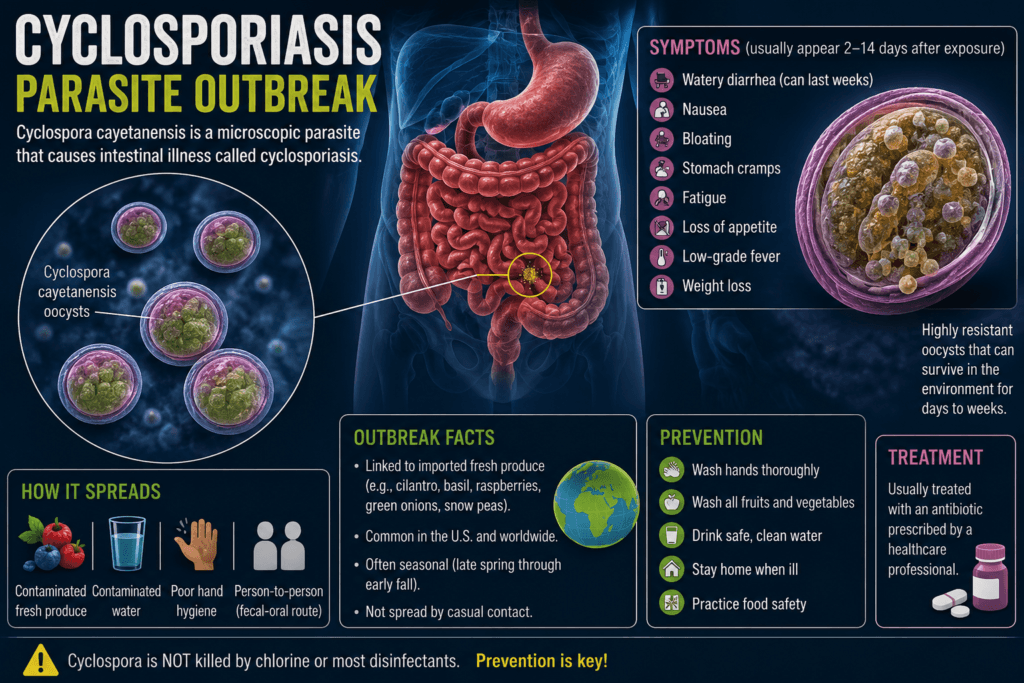
The Current Reality: The Grocery Aisle Under a Microscope
Take a look at what is happening in corporate food distribution right now. The Centers for Disease Control and Prevention (CDC) and state health officials are actively tracking a massive Cyclospora parasite outbreak tearing through more than 31 states. Michigan alone has confirmed over 1,500 cases of severe illness, with hundreds more reported across Ohio. Public health alerts are explicitly warning consumers and restaurants about an outbreak causing agonizing weeks of explosive, watery diarrhea linked directly to contaminated, raw commercial fresh produce.
The mainstream food industry operates on a model of “process expectations,” while the raw milk industry is forced to meet strict “product reality.”
Simultaneously, federal regulators have launched an urgent multi-state investigation into a dangerous E. coli O145 outbreak. The culprit? Packages of recalled GreenWise frozen organic blueberries shipped to grocery locations across eight states. Multiple people have already been hospitalized after pulling those organic berries straight from the freezer for their morning smoothies.
When these mass-distribution failures hit the headlines, federal agencies issue a polite recall notice and ask you to wash your blender. No one calls for an outright ban on spinach, basil, or frozen fruit.
Flipping the Safety Rhetoric on Its Head
You have heard the dramatic institutional warnings for years. Public health officials routinely label unpasteurized dairy as an extreme biological gamble. Media headlines treat raw milk like roulette, suggesting that skipping pasteurization guarantees immediate illness and the very digestive issues currently filling hospital wards.
Yet, when you strip away the institutional bias and analyze the actual legal frameworks, you find a fascinating double standard. Your local raw milk safety standards are incomparably stricter, more frequently tested, and more legally penalized than the regulations governing the commercial produce aisle.
The fundamental difference comes down to what regulators actually look at: the final food product versus the agricultural inputs.
- Raw Milk: State laws regulate raw milk as a ready-to-consume food. They mandate direct product testing. Regulators pull samples directly from the exact bottle or bulk tank you drink from to verify cleanliness.
- Fresh Produce: The FDA Food Safety Modernization Act (FSMA) Produce Safety Rule does not require routine microbial testing of actual fruits and vegetables. Instead, it focuses entirely on environmental risk assessments of your water system and compost intervals.
The Pathogen Breakdown: How Invaders Hide in Your Salad
Fruits and vegetables are not dangerous because of their shape or texture alone. The real issue is contamination upstream, while texture mainly affects how well microbes can stick, hide, or persist long enough to make someone sick. Depending on the pathogen, that upstream contamination can come from different sources: the Cyclospora parasite is linked to human fecal contamination, while some E. coli outbreaks can involve cattle or other animal operations.
Cyclospora Parasite
The Cyclospora parasite is less like a fast-moving invader and more like a hitchhiker hiding in the folds of leafy greens, herbs, berries, and cut produce. It gets onto fruits and vegetables through contaminated water or fecal contamination, and rough, crinkled, or layered surfaces can give it more places to linger until it reaches the plate. A single Cyclospora parasite can survive on crop surfaces long enough to bypass standard consumer preparation, making surface washing an unreliable defense.
E. coli
E. coli is more like Velcro on the wrong surface: it can latch onto leafy greens, cut fruit, and vegetables with rough spots, creases, or damaged skin. In some cases, it can even tuck into tiny openings or surface irregularities, which is why washing helps but does not guarantee removal.
Microbial Limits: Hard Numbers vs. Process Expectations
State raw milk safety standards rely on strict, quantifiable indicator benchmarks. If a dairy farmer exceeds these numbers, they lose their license. The produce industry operates under a highly flexible model where zero bacteria is recognized as an outdoor impossibility. The ongoing Cyclospora parasite crisis demonstrates how easily pathogens bypass standard agricultural checks. Instead, produce regulations target the inputs supplying the fields:
- Agricultural Water Quality: Under the updated FSMA rules, produce farms must conduct an annual Agricultural Water Assessment. This is a qualitative, written review of the water source and distribution network. It completely replaces fixed numerical microbial cutoffs for pre-harvest water.
- Biological Soil Amendments: FSMA establishes strict microbial limits for treated compost, but for untreated raw manure, the FDA relies on application-to-harvest intervals (typically 90 to 120 days) rather than testing the soil or the crop itself.
Raw Milk State Standards
By contrast, state frameworks monitor explicit bacterial counts to evaluate herd health and farm hygiene. Common regulatory limits for raw milk from dairy cattle include:
- Standard Plate Count (SPC): Legally capped between 10,000 and 50,000 CFU/ml depending on the state. This measures total aerobic bacteria to grade cooling efficiency and equipment sanitation.
- Coliform Count: Restricted to a maximum of 10 to 50 CFU/ml. High coliform counts serve as an immediate regulatory indicator of environmental or fecal contact during milking.
- Somatic Cell Count (SCC): Enforced strictly at the state level (Pennsylvania, for example, caps dairy cattle at 400,000 cells/ml). This measures white blood cells to monitor for mastitis (udder infection).
Pathogen Testing: The Sprout Exception
Routine pathogen screening of final crops is virtually non-existent in commercial produce agriculture. The organic blueberries that caused the E. coli outbreak were never tested for pathogens before entering commerce. Pathogen testing for produce typically happens after people start getting sick and epidemiologists track the infections backward. Similarly, random testing for the Cyclospora parasite is not mandated for commercial harvests.
The only exception to this rule is sprouts. Because sprouts grow in warm, humid conditions that rapidly multiply bacteria, sprout operations must test spent irrigation water for Salmonella and E. coli O157:H7 before shipping.
Raw milk dairies face a much higher bar. Dairies adhering to the voluntary Common Standards of the Raw Milk Institute (RAWMI) must prove their milk contains zero pathogens. Many of these farms build micro-scale, on-farm laboratories using petri-films or peel-plates to run pathogen testing on every single batch lot, getting data within 24 to 48 hours to ensure zero-risk distribution.
Testing Frequency and Enforcement Realities
The operational cadence required to maintain legal compliance highlights the true gap in regulatory oversight between these two agricultural sectors.
| Safety Feature | State Raw Milk Laws | FSMA Produce Safety Rule |
| Testing Frequency | High. Monthly state inspector sampling, paired with voluntary daily or weekly internal batch testing. | Low. Annual qualitative water assessments and event-driven testing if a specific hazard is observed. |
| Primary Regulatory Body | State Departments of Agriculture or State Health Departments. | Federal FDA (frequently delegated to State Ag inspectors). |
| Immediate Penalties | Automatic Suspension. Exceeding SPC or coliform limits over consecutive tests results in immediate permit revocation. | Mitigation Plan. Discovering a water hazard triggers a requirement to implement corrective measures within the same growing season. |
Structural Compliance vs. Risk Management
State raw milk safety standards lean heavily on binary, structural compliance. To keep your license, you must pass physical inspections of your stainless steel plumbing, milk room walls, and barn construction, while keeping your monthly random milk samples below the legal bacterial limit.
The voluntary RAWMI standards take this further by mandating a Risk Analysis and Management Plan (RAMP). Instead of checking off bureaucratic boxes, a RAMP forces the farmer to map out every single point of potential contamination on their specific property. A comprehensive RAMP details exact protocols for pasture mud management, step-by-step udder preparation, and immediate cooling sequences to keep bacteria levels near zero.
When you evaluate the actual metrics side by side, the voluntary standard targets demonstrate an elite tier of clean food production.
| Metric | Typical State Raw Milk Law | RAWMI Common Standards | FSMA Produce Rule |
| Standard Plate Count | 10,000 to 50,000 CFU/ml | Under 5,000 CFU/ml (Rolling Average) | No Limit (Not Tested) |
| Coliform Count | 10 to 50 CFU/ml | Under 10 to 25 CFU/ml (Rolling Average) | No Limit (Not Tested) |
| Pathogen Action | Variable state screening | Zero Tolerance (Mandatory Testing) | Post-Outbreak Traceback Only |
Actionable Takeaways for Your Readers
The next time you read an official warning about the perils of raw dairy, look over at the pre-washed salad greens or frozen berries in your kitchen. The farmer who produced your raw milk operates under a regulatory microscope, chasing ultra-low bacterial counts and managing micro-biorisks on a daily basis. If the mainstream media spent as much time tracking the Cyclospora parasite as they do criticizing small dairies, the produce aisle would look completely different.
To navigate this landscape safely as a consumer, follow these three practical steps:
- Verify the Farm’s Testing Protocol: Ask your local dairy producer if they test every batch lot or rely strictly on monthly state tests. Premium producers will happily share their SPC and coliform averages.
- Look for RAMP Compliance: Choose farms that have a written Risk Analysis and Management Plan in place. This proves the farm explicitly manages environmental hazards rather than just reacting to bad inspection numbers.
- Know Your State Metrics: Every state has different legal limits for raw milk. Understanding the exact benchmarks enforced in your region helps you grade the baseline safety of your local options. Use our internal database to view the rules for your specific state.
🦠 Public health officials demand absolute perfection from small dairies while giving corporate produce a free pass on routine testing. How do you feel about this food safety double standard? Let’s talk about it in the comments. 👇
Related Reading: Publix E. coli Outbreak: What It Reveals About Food Safety & Raw Milk — What a major recall on organic frozen berries tells us about food safety standards and accountability.
Explore the Map: Find Tested, Real Raw Milk Near You — Locate vetted, local farms adhering to strict raw dairy safety protocols.

Author: Team FRM
The FindingRawMilk Team is dedicated to building the most comprehensive and transparent directory for raw milk enthusiasts. Our mission is to bridge the gap between local farms and consumers by providing verified listings, clear state-by-state legal guides, and educational resources. We believe in the importance of food freedom and strive to make sourcing high-quality, farm-fresh milk as simple as a single search.



Leave a Reply