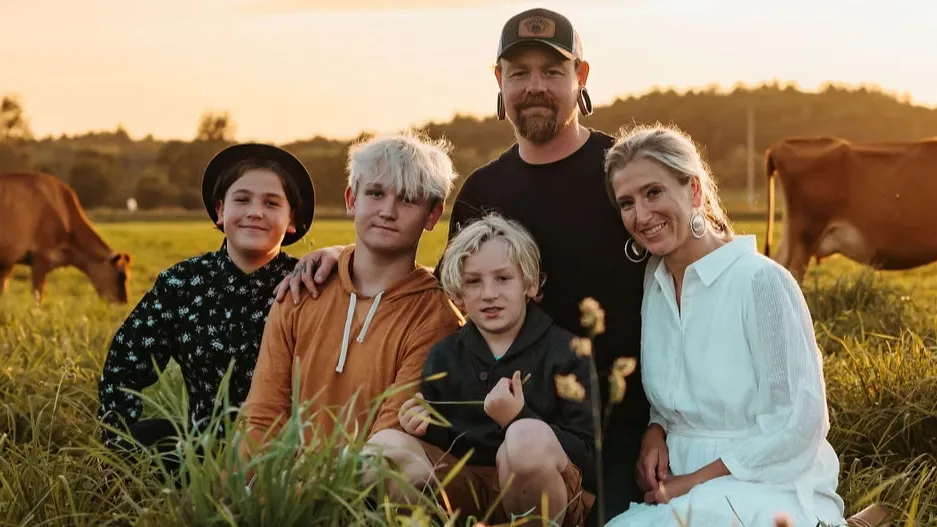
For six years, Grassway Organics operated under a Wisconsin dairy license, serving families who wanted a direct connection to the farm producing their milk. The farm says it worked with state regulators to establish its cooperative ownership model, underwent inspections, and invested in food safety practices.
Now, the Wisconsin Department of Agriculture, Trade and Consumer Protection (DATCP) is pursuing enforcement action against that same operation.
For Chaz and Megan Self, who run Grassway Organics in East Troy, Wisconsin, the consequences could be devastating. Their family farm, their livelihood, and the community they’ve spent years building are all at stake.
The Selfs maintain that their operating model hasn’t changed and that Wisconsin’s existing regulations permit the distribution of raw milk to individuals with genuine ownership interests in a dairy operation.
The state disputes whether the farm’s arrangement qualifies.
Finding Raw Milk stands with Grassway Organics and the Self family in their fight for fair treatment, regulatory accountability, and the opportunity to defend their farm.
A family that openly worked with regulators should be able to rely on clear, consistently applied rules. If the state believes the farm’s ownership arrangement violates those rules, it should explain precisely why, including how its present interpretation relates to the farm’s years of licensed operation.
This case deserves attention because the consequences extend beyond one Wisconsin dairy. Other small farms and families who depend on direct relationships with local producers have a stake in how these rules are interpreted and enforced.
Hear Directly From Chaz Self
Chaz Self has released a video explaining the farm’s history, its relationship with Wisconsin regulators, and the legal battle now threatening the family’s future.
He describes the work involved in establishing Grassway Organics, the investments made in safety and compliance, and the emotional toll of defending the farm.
His message is personal, but the questions he raises concern the future of small dairy farming and raw milk access in Wisconsin.
We encourage readers to hear the family’s account directly and review the available regulatory information and legal updates.
A Family Farm Built on Trust, Transparency, and Community
Grassway Organics is a family-operated dairy farm in Walworth County, Wisconsin. Chaz and Megan Self operate the farm alongside their three sons, providing raw dairy products to families who have established ownership relationships with the operation.
The family developed a cooperative model designed to give consumers a direct connection to the farm producing their food.
According to Chaz Self, the farm approached DATCP about its proposed arrangement and worked with the department before receiving a Grade A dairy license in March 2020.
Rather than operating quietly or attempting to avoid regulatory oversight, the Selfs say they built their business around the state’s existing rules.
They also invested in food safety measures beyond the basic requirements of their license.
Grassway Organics became certified through the Raw Milk Institute (RAWMI), an organization that establishes risk management and testing standards for raw milk producers.
According to Self, the farm implemented daily on-farm testing, written risk management procedures, and documented critical control points. He also says Grassway Organics became the first Wisconsin dairy to obtain raw milk liability insurance.
These measures do not eliminate the potential health risks associated with unpasteurized milk, nor do they independently establish legal compliance. They do, however, demonstrate the family’s stated commitment to operating transparently and managing production risks.
The farm’s efforts make the state’s enforcement action particularly troubling.
If a producer approaches regulators, obtains a license, undergoes inspections, and builds a business around its understanding of an existing regulation, what happens when the agency later challenges that interpretation?
For Grassway Organics, that question is no longer theoretical. The family’s future may depend on the answer.
How Six Years of Licensed Operation Became a Fight for Survival
According to Grassway Organics and its legal representatives, the farm operated under its cooperative ownership arrangement for approximately six years before DATCP moved to suspend its license.
The conflict began escalating in 2025, when state inspectors began examining the farm’s distribution records and questioning its operating model.
Self says the department had previously been aware of the arrangement and that nothing material had changed about how the farm operated.
By April 2026, the situation had become a full legal confrontation.
DATCP suspended Grassway Organics’ milk producer license and proposed financial penalties, including a $10,000 fine and additional penalties for continued operation.
The Self family challenged the enforcement action, arguing that their cooperative ownership arrangement is permitted under Wisconsin’s existing administrative code.
Timeline of the Grassway Organics Dispute
- March 2020: Grassway Organics receives its Wisconsin dairy license and begins operating under its cooperative ownership arrangement, according to the farm.
- 2025: DATCP begins questioning the farm’s distribution practices and requests records related to its operations.
- March 18, 2026: DATCP issues a special order concerning the farm’s business practices.
- April 21, 2026: DATCP issues an order suspending the farm’s milk producer license.
- September 28, 2026: Grassway Organics seeks court intervention to prevent enforcement while challenging the state’s actions.
- October 7, 2026: The court declines to issue the requested temporary restraining order and requests additional briefing concerning injunctive relief.
- November 30, 2026: A decision on the farm’s request for an injunction is expected.
- May 24–26, 2027: An administrative hearing is scheduled to address the underlying enforcement dispute.
The legal proceedings are ongoing, and the farm’s challenge has not yet received a final determination.
For the Self family, however, the financial and operational consequences are already substantial.
The Wisconsin Raw Milk Rule at the Center of the Fight
At the heart of the dispute is Wisconsin Administrative Code ATCP 65.52, which governs the sale and distribution of unpasteurized milk.
Wisconsin generally prohibits raw milk sales to consumers, but the regulation contains specific exemptions.
One of those exemptions, ATCP 65.52(2)(b), permits distribution of unpasteurized milk to an individual with a bona fide ownership interest in the dairy farm and milking operation, subject to the provision’s requirements.
This is the provision Grassway Organics says it relied upon when developing its cooperative model.
The farm maintains that its members possess legitimate ownership interests and that the arrangement was established with the knowledge of state regulators.
DATCP’s published guidance, however, distinguishes genuine ownership from arrangements created primarily to obtain raw milk. The department states that sham investments do not establish bona fide ownership and that cow-share or herd-share arrangements do not automatically qualify.
The question is whether Grassway Organics’ particular cooperative structure satisfies the legal definition.
Self also argues that the state has improperly evaluated the farm under a separate provision, ATCP 65.52(4), which addresses limited incidental raw milk sales.
Grassway Organics maintains that its distribution model is based on ownership rather than incidental sales.
These are separate provisions with different requirements, and the distinction matters.
If Wisconsin’s regulations recognize bona fide farm ownership as a basis for receiving raw milk, farmers need a clear and reliable understanding of what constitutes that ownership.
A rule that is difficult to interpret, or whose application appears to change after years of licensed operation, creates uncertainty for farmers attempting to comply.
The state has a responsibility to enforce its laws. Farmers also deserve clear standards, consistent treatment, and a meaningful opportunity to challenge regulatory decisions that threaten their businesses.
The Self family is asking for precisely that opportunity.
For additional background, see Wisconsin’s raw milk regulations and Wisconsin Administrative Code ATCP 65.52.
Readers can also explore Finding Raw Milk’s state raw milk laws guide to understand how access differs across the country.
Why the State’s Actions Deserve Greater Scrutiny
Perhaps the most troubling aspect of this dispute is Grassway Organics’ account of its relationship with state regulators.
The Self family says it did not develop its cooperative ownership model in secret.
According to Chaz Self, the farm presented its proposal to DATCP, worked through the regulatory requirements, obtained a license, and continued operating under state oversight.
For years, the family believed it had established a lawful way to serve its members.
Now, the department is challenging the arrangement.
If the farm’s account is accurate, the public deserves to understand what changed.
Did regulators previously review and accept the cooperative ownership structure? Did the department change its interpretation of the applicable regulation? Were specific deficiencies identified that had not been addressed during earlier inspections?
These are reasonable questions, especially when the consequences include license suspension, financial penalties, and the possible loss of a family business.
Wisconsin Public Radio has reported on the dispute and sought responses from DATCP. The department declined to answer certain questions concerning its earlier involvement with the farm, citing pending litigation.
That leaves important aspects of the regulatory history unresolved.
It would be premature to conclude that earlier licensing and inspections constituted formal legal approval of every aspect of the cooperative arrangement.
But that uncertainty strengthens the case for transparency.
Farmers should not have to risk their livelihoods to discover how a state agency interprets a regulation governing their business.
When enforcement threatens the survival of a licensed family farm, the reasoning behind that enforcement deserves careful public examination.
The Human Cost: A Family Fighting for Its Home and Future
Behind the regulatory provisions and legal filings is a family trying to protect what it has built.
In a public video explaining the dispute, Chaz Self describes the emotional and financial pressure of fighting the state while continuing to manage a working dairy farm.
The family faces substantial legal expenses, the possibility of ongoing financial penalties, and uncertainty about whether its business can survive.
Self estimates that the legal battle could cost approximately $160,000, including attorney fees, expert testimony, document production, and potential appeals.
Those are anticipated legal defense expenses, not penalties imposed by a court.
For a small family farm, that is an enormous financial burden.
And the costs extend beyond money.
The Selfs have three sons who are watching their parents fight to preserve the family business. The farm also serves families who have developed relationships with the operation and depend on it for their dairy products.
The possibility of losing the farm affects everyone connected to it.
Self has spoken about the difficulty of explaining the situation to his children and the fear of losing both the family’s livelihood and the place they call home.
His appeal also raises a question worth considering: What message does a dispute like this send to the next generation of farmers?
Starting a dairy farm is already difficult. Land, equipment, infrastructure, labor, and operating expenses create significant barriers.
When a family believes it has followed the rules and still faces a prolonged legal battle over its ability to operate, other aspiring farmers may reasonably question whether they can afford to take the same risk.
Wisconsin has already experienced a dramatic decline in dairy farm numbers over recent decades.
At a time when the state continues losing dairy operations, preserving opportunities for smaller, independent producers should be a serious public priority.
Grassway Organics found a business model that allowed it to build direct relationships with its customers and support its family.
Whether that particular model satisfies Wisconsin law remains before the legal system.
But the family’s willingness to defend it deserves attention and support.
Why This Fight Matters to Raw Milk Farmers Everywhere
Although the dispute centers on one Wisconsin farm, the underlying issues reach beyond state borders.
Across the United States, raw milk laws vary considerably.
Some states permit retail sales. Others allow on-farm purchases, direct delivery, herd-share arrangements, or distribution through specific ownership structures. Several states maintain significant restrictions.
For farmers, understanding and complying with these different rules can be complicated.
For consumers, the regulations determine whether they can legally obtain raw dairy products from local producers.
Grassway Organics’ legal challenge raises questions about how ownership exemptions should be interpreted, how agencies communicate compliance requirements, and how farmers can obtain reliable guidance before investing in their businesses.
A decision in this case could help clarify Wisconsin’s ownership exemption, although its broader effect will depend on the legal reasoning and any subsequent appeals.
There is also a larger issue at stake.
Small farms need a realistic opportunity to survive outside conventional commodity markets.
Direct relationships between farmers and consumers can help producers retain more of the value of their products while giving families a closer connection to the source of their food.
These relationships deserve thoughtful regulation and clear legal standards.
Food safety and farm access are both legitimate public concerns. Regulatory oversight should protect consumers while providing farmers with understandable, consistently applied requirements.
Supporting Grassway Organics does not require dismissing food safety concerns or assuming that every claim made by the farm has already been proven.
It means recognizing that a family facing potentially devastating enforcement action deserves a fair hearing, clear explanations, and an opportunity to defend the business it has spent years building.
That is why Finding Raw Milk believes this case matters.
Stand With Grassway Organics: How You Can Help
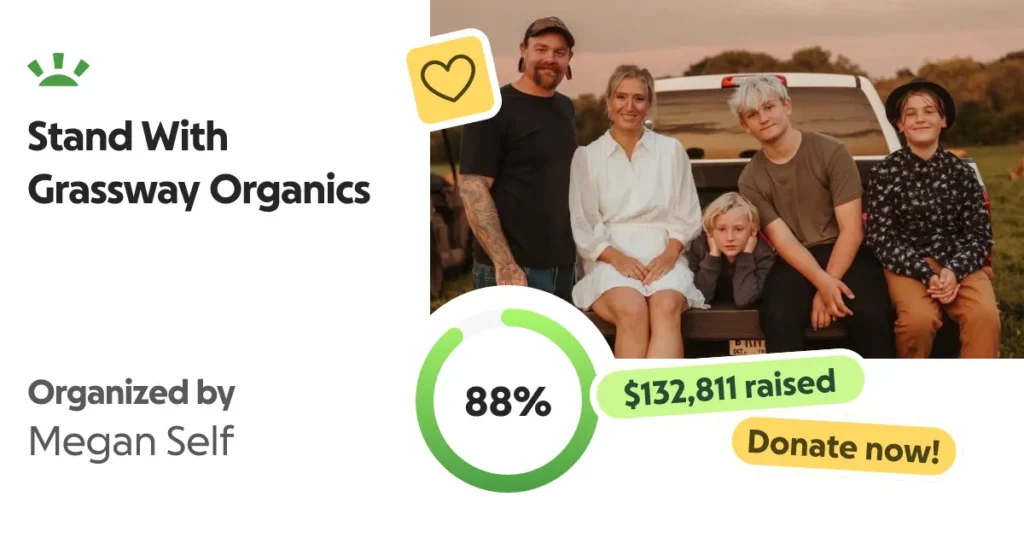
Grassway Organics is asking for public support as the Self family prepares for the next stages of its legal fight.
There are several meaningful ways to help.
1. Support the Family’s Legal Defense
The Self family has established a GoFundMe campaign to help cover legal expenses.
Donations can help fund attorney fees, expert testimony, and other costs associated with challenging the state’s enforcement actions.
Stand With Grassway Organics: Support the Family's Legal FightContributions are made directly through the external fundraising platform.
2. Share the Family’s Story
Public awareness matters.
Share Chaz Self’s video, this article, and the fundraiser with people who care about local agriculture, family farms, food access, and fair regulatory treatment.
Many people outside Wisconsin may not be familiar with the dispute or understand its potential implications.
Helping others learn what is happening is a meaningful form of support.
3. Ask Wisconsin Officials for Clarity and Accountability
Wisconsin residents can contact their elected representatives and ask questions about the state’s raw milk regulations and the treatment of licensed family farms.
Questions worth asking include:
- How does Wisconsin define a bona fide ownership interest in a dairy farm?
- What guidance is available to farmers seeking to comply with ATCP 65.52(2)(b)?
- How can producers obtain reliable confirmation that their ownership arrangements satisfy the regulation?
- What safeguards exist when an agency changes its interpretation or enforcement approach?
- What can lawmakers do to provide clearer legal pathways for small dairy farms and consumers?
Citizens can support regulatory accountability and clearer laws while respecting the ongoing judicial process.
4. Follow the Legal Proceedings
The Farm-to-Consumer Legal Defense Fund has published updates about Grassway Organics’ case.
The next reported injunction decision is expected on November 30, 2026, with an administrative hearing scheduled for May 2027.
Read the October 8 legal update from the Farm-to-Consumer Legal Defense Fund.
Following verified developments will help keep attention on the case as it moves through the legal system.
Finding Raw Milk Stands With Grassway Organics
Grassway Organics represents something worth protecting: a family committed to farming, a community connected to its food source, and a small agricultural business trying to operate within the law.
The Self family says it approached regulators, obtained a license, invested in safety measures, and spent years building a farm around an ownership arrangement it believed was permitted.
Now, that farm faces a legal and financial fight that could determine whether the family can continue its work.
The courts and administrative proceedings will determine the legal merits of the dispute.
But the public does not need to wait for a final ruling to ask whether farmers are receiving clear guidance, consistent treatment, and a fair opportunity to defend their livelihoods.
Finding Raw Milk stands with Chaz and Megan Self, their family, and the community supporting Grassway Organics.
We believe small farms deserve clear regulations, fair enforcement, and viable opportunities to serve the people who depend on them.
We also believe the public deserves answers when a licensed family farm faces potentially devastating enforcement action after years of operating under state oversight.
If you believe family farms deserve a fair chance, take a few minutes to watch Chaz Self’s story, share it with others, and consider supporting the family’s legal defense.
Their fight deserves to be heard.
Stand With Grassway Organics: Support the Family's Legal Fight
Follow Grassway Organics on Facebook and Instagram
Sources and Further Reading
- Wisconsin DATCP: Raw Milk Regulations and Guidance
- Wisconsin Administrative Code ATCP 65.52
- Wisconsin Public Radio: Grassway Organics License Suspension Coverage
- Farm-to-Consumer Legal Defense Fund: September 29, 2026 Case Announcement
- Farm-to-Consumer Legal Defense Fund: October 8, 2026 Legal Update
- Grassway Organics: Stand With Our Family Fundraiser
- Chaz Self: Grassway Organics Video Statement

Author: Team FRM
The FindingRawMilk Team is dedicated to building the most comprehensive and transparent directory for raw milk enthusiasts. Our mission is to bridge the gap between local farms and consumers by providing verified listings, clear state-by-state legal guides, and educational resources. We believe in the importance of food freedom and strive to make sourcing high-quality, farm-fresh milk as simple as a single search.


Leave a Reply